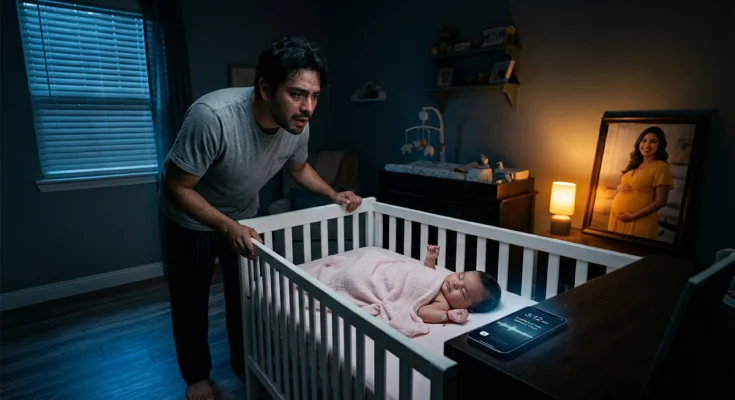
PART 5 >> My wife died giving birth to our daughter, and I hated that baby from her very first cry. Six weeks later, I walked into her room determined to let her cry herself out, until I saw something tied around her wrist. It was a little red bracelet. I hadn’t put it on her. And under her pillow was my dead wife’s cell phone, powered on.
Room 304 was already loud with the rhythmic beeping of the fetal monitor when April stepped inside, snapping on a fresh pair of sterile gloves.
A young couple was inside—the mother pale and trembling against the raised pillows, her husband gripping her hand so tightly his knuckles had gone white. The labor nurse glanced up in relief as April walked over to the bedside.
“Heart rate’s dipping during contractions, Doctor,” the nurse said briskly. “And her blood pressure’s dropping fast.”
April stepped closer, her eyes scanning the vitals screen before dropping to the paper chart on the rolling tray. For a fraction of a second, a chill ran down her spine. The intake markers—the sudden drop in pressure, the subtle warning signs buried under routine notes—looked hauntingly familiar.
“Let’s prep the OR immediately,” April said, her voice calm, clear, and commanding. “And call the blood bank myself—I want two units of O-negative cross-matched and standing by before we move her. Verify the batch numbers with me in person.”
The nurse nodded and hurried toward the phone.
April leaned down beside the bed, placing a steady, reassuring hand over the mother’s trembling arm. Beneath the cuff of April’s white coat, the tiny St. Christopher medal on her red bracelet clicked softly against the bedrail.
“Look at me,” April told the woman gently. “You are going to be okay. Both of you are going to make it through this. I promise.”
The husband stared at April with desperate gratitude, whispering a quiet thank you as the transport team rolled through the doorway.
Three hours later, the sun was just beginning to rise over the city skyline, casting pale gold light down the quiet corridor of the maternity ward.
Both mother and newborn were resting safely in recovery, their vitals steady and strong.
April walked slowly toward the hospital lobby, shedding her white coat over one arm, exhausted down to her bones yet lighter than she had ever felt in her life.
Through the glass double doors, standing beside a parked pickup truck with two steaming paper cups of coffee and a small bakery box in his hands, was Ignacio. His hair was silver at the temples now, and laugh lines creased the corners of his eyes as he spotted her walking out.
“Rough night, Doctor?” he asked warmly, handing over a cup as she stepped out into the crisp morning air.
“A good night, Dad,” April smiled, wrapping both hands around the warm coffee.
She glanced down at the worn red string on her wrist, catching the first rays of morning sun on the tiny silver medal, and leaned her head briefly against her father’s shoulder—knowing that somewhere, Marina was finally at rest.
That afternoon, the small park across from the bakery was filled with white folding chairs, strings of warm fairy lights, and the scent of blooming jasmine.
Ignacio stood near the wooden arch at the center of the garden, adjusting the lapel of his charcoal suit with slightly trembling hands. Behind him, a framed photograph of Marina in her yellow dress rested on a small easel adorned with white roses—front and center, just as April had insisted.
When the soft melody of an acoustic guitar drifted across the lawn, the guests turned toward the garden path.
April walked down the aisle in a simple, flowing ivory dress, holding a bouquet of yellow wildflowers—Marina’s favorites. On her right wrist, visible against the delicate lace of her sleeve, rested the little red bracelet with the tiny St. Christopher medal.
When she reached the arch, Ignacio stepped forward to take her hand, his eyes shining with tears he didn’t bother to hide.
“You look just like her,” he whispered so only she could hear.
April smiled, squeezing his fingers before turning slightly toward the framed photograph beside them.
“She’s here, Dad,” April murmured softly. “She never left.”
As the vows began under the golden late-afternoon sun, Ignacio stepped back into the front row beside Elena, watching his daughter start a family of her own—knowing that the love Marina had fought to leave behind hadn’t ended in that hospital room after all, but had grown into everything standing before him today.
Two years after the garden wedding, the soft hum of a baby monitor echoed quietly through the living room of a sunlit house just down the street from the bakery.
Ignacio sat on the sofa with a steaming mug of coffee, watching the screen as his granddaughter—little Marina, named after the mother she had never met—stirred from her afternoon nap. On the side table beside him rested a silver-framed photo of his late wife in her yellow dress, bathed in the golden light of the afternoon.
The front door clicked open, and April walked in, carrying two paper bags from the bakery and a worn canvas medical bag slung over her shoulder. She kicked off her flats, let out a long, contented sigh, and set the bags on the kitchen counter.
“Rough afternoon at the clinic?” Ignacio asked softly, leaning back against the cushions.
“Just busy,” April smiled, walking over and resting a hand on her father’s shoulder as she looked down at the monitor. “Two new moms went home today. Healthy, steady, and smiling.”
Upstairs, a faint, sleepy coo came through the speaker.
April went up to get her daughter, returning a few minutes later with the little girl wrapped in a soft blanket, resting comfortably in her arms. As April sat beside Ignacio on the sofa, the baby’s tiny hand reached out, brushing against the edge of the little red bracelet with the St. Christopher medal still worn on April’s wrist.
Ignacio reached over, gently placing his hand over both of theirs—his daughter’s, his granddaughter’s, and the quiet thread of love that had held them together through every storm.
“You know,” Ignacio said quietly as the late-afternoon sun stretched across the floor, “your mom would have loved being a grandma.”
April looked down at her daughter, smiling with a peace that had taken years to build and would never fade. “She already is, Dad. Look at her.”
Little Marina let out a soft sigh, curled her fingers around her mother’s thumb, and drifted back to sleep—safe, loved, and part of a story that began in grief, found truth in the dark, and lived on in every breath they took.
Years later, little Marina is growing up surrounded by family, the warmth of Ignacio’s bakery, and the legacy of maternal care that April champions every day. The story closes on a lasting sense of healing and continuity, showing how love and truth turned a devastating beginning into a thriving generational bond.