PART 4 — MY DAUGHTER BEGGED ME NOT TO CALL THE BANK, BUT THE TRUTH WAS ALREADY WAITING FOR ME
“Mama, I can explain.”
Those four words came through the telephone so quietly that, for one foolish moment, I almost believed my daughter was finally ready to tell me the truth.
I sat at my kitchen table with one hand wrapped around the telephone and the other resting on the blue folder.
“Then explain, Jillian.”
She didn’t answer.
I heard Daniel speaking in the background.
“Jill, just tell her what happened.”
“Stay out of this, Daniel!”
Something slammed.
Then my daughter returned to the phone.
“Mama, before I say anything, I need you to promise me something.”
I looked toward the framed photograph of Harold hanging beside the kitchen window.
“What promise?”
“Promise you won’t call the police.”
My stomach dropped.
I had asked about my house.
She had answered with the police.
“Jillian, what have you done?”
“Nothing that can’t be fixed.”
“That isn’t what I asked.”
“Mama, please.”
Her voice cracked.
And suddenly I heard the little girl who used to cry when she’d broken something important.
The little girl who would hide a shattered vase behind the couch and hope I wouldn’t notice.
But this wasn’t a vase.
This was my home.
“Jillian, did you sign my name on something?”
A long silence followed.
Then she whispered, “I thought I could pay it back before you found out.”
My breath caught.
“Pay what back?”
“Some money.”
“How much money?”
“Mama—”
“How much?”
She began crying.
I had heard my daughter cry hundreds of times.
When she broke her arm at eleven.
When her first husband walked out.
When Mitchell left for college.
But I had never heard her cry quite like this.
There was fear in it.
Real fear.
“Twenty-eight thousand dollars,” she whispered.
For a moment, the room seemed to tilt.
“Twenty-eight thousand?”
“I didn’t take it all at once.”
I pressed my palm against the table.
“Jillian, what does that have to do with my house?”
She was breathing hard.
“They needed proof that I had assets. I used some old paperwork. I didn’t think anything would happen.”
“What old paperwork?”
“The documents from when Daddy died.”
I closed my eyes.
Harold had been gone eleven years.
Eleven years since I’d held his hand in the hospital and promised him I would take care of our family.
Eleven years since I’d folded his favorite blue work shirt and put it in the bottom drawer because I couldn’t bear to give it away.
And now my daughter was telling me she’d used paperwork connected to his death to borrow money.
“Jillian, did you put a lien on my house?”
“I don’t know if that’s what they called it.”
“Did you tell somebody my house was yours?”
She began crying harder.
“I told them I’d inherit it someday.”
I stared at the wall.
“But I am still alive.”
“I KNOW THAT, MAMA!”
Her shout made Biscuit jump.
Then her voice fell to a whisper.
“I wasn’t thinking.”
I waited.
She kept talking.
“I was behind on bills. I was trying to catch up. I thought I’d get a better job, pay everything off, and nobody would ever know.”
“Where did the money go?”
“Credit cards.”
“All of it?”
She hesitated.
That hesitation told me more than her answer.
“Jillian.”
“Some of it went to other things.”
“What other things?”
“Please don’t make me do this over the phone.”
I looked down at my hands.
They were trembling.
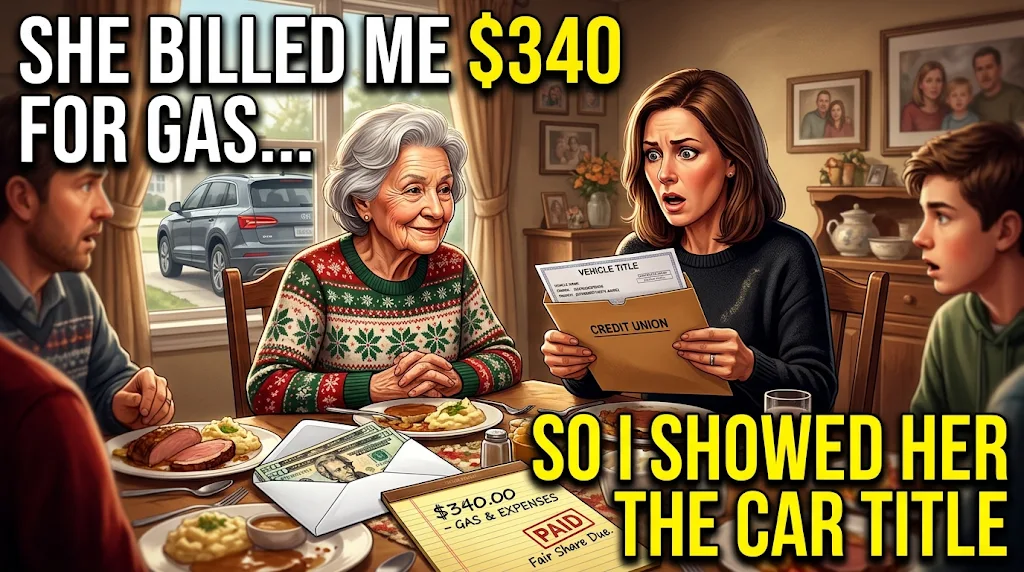
I thought about the $340 she’d demanded from me.
The way she’d counted those twenty-dollar bills right at my dinner table.
The way she’d smiled and said, “See, that wasn’t so hard.”
All while she was hiding a much larger financial disaster.
I wanted to scream.
Instead, I asked one question.
“Jillian, did you know what you were asking me to sign tonight?”
Silence.
Then a tiny voice.
“Yes.”
I felt something inside me crack.
“Was that power of attorney supposed to help you get more money?”
“No.”
“Then what was it for?”
Another silence.
“To straighten out the paperwork.”
“By giving you permission to act in my name?”
“Mama, it would have made things easier.”
“For whom?”
She had no answer.
I took a slow breath.
“Jillian, tomorrow morning I’m calling the credit union and the county recorder’s office. I’m going to find out exactly what is attached to my name and my property.”
“No!”
Her voice came out sharp.
“You can’t!”
“Why?”
“Because they’ll investigate!”
I closed my eyes.
“Then perhaps something needs investigating.”
She began sobbing.
“Mama, I’ll lose everything.”
I looked around my kitchen.
At the curtains I’d sewn myself.
At the worn oak table Harold had refinished.
At the little crack in the ceiling we’d always meant to repair.
“And what happens if I lose everything, Jillian?”
She didn’t answer.
“Where would I go?”
“Mama…”
“Would you let me live with you?”
She started to speak.
Then stopped.
And somehow that silence hurt more than everything else she’d said.
I whispered, “Goodnight, honey.”
Then I hung up.
I sat there until the clock struck ten.
For the first time since Harold died, I wished with all my heart that he were sitting across from me.
He’d know what to say.
Or maybe he wouldn’t.
Maybe he’d be just as heartbroken.
I reached for his photograph.
“Harold,” I whispered, “I think our little girl has gotten herself into something terrible.”
Biscuit rested his head on my slipper.
I stroked his ears.
Then I did something I hadn’t done in years.
I took out the small notebook where I used to keep our household accounts.
On the first clean page, I wrote:
WHAT I KNOW.
Underneath, I listed every fact I could remember.
The SUV title was in my name.
The last payment had been made.
Daniel had found a suspicious copy with my signature.
Jillian had admitted borrowing money.
My home address appeared on the paperwork.
She had asked me to sign a power of attorney.
And she had begged me not to contact anyone.
At the bottom, I wrote one final sentence.
DO NOT SIGN ANYTHING.
Then I went to bed.
I didn’t sleep much.
At seven the next morning, my telephone rang.
It was Mitchell.
“Grandma, are you okay?”
I tried to sound cheerful.
“Of course, sweetheart.”
“Mom called me last night.”
My heart sank.
“What did she say?”
He hesitated.
“She said you’re confused.”
I sat upright.
“Confused?”
“She said your eyesight is getting worse and you’ve been misunderstanding paperwork.”
I felt a coldness settle in my chest.
“Did she?”
“She told me you might start saying things about her that aren’t true.”
I closed my eyes.
There it was.
The next step.
If she couldn’t make me sign the papers, perhaps she could convince everyone that I didn’t understand them.
“Mitchell, what did you tell her?”
“I told her you know exactly what you’re doing.”
My eyes filled with tears.
He continued.
“Then she got mad and said I was turning against her.”
“Oh, sweetheart.”
“Grandma, I’m not choosing sides. I just don’t like what she’s doing.”
I swallowed hard.
“I know.”
“Can I come over?”
“Please do.”
An hour later, Mitchell arrived with his laptop and the determination of a young man who had finally decided he was tired of being treated like a child.
He sat at my table and helped me make a list of places to call.
The credit union.
The county treasurer’s office.
The county recorder’s office.
A local attorney who handled property and estate matters.
“Grandma, we should make copies of everything.”
“That’s exactly what I was thinking.”
He looked at me.
“You really aren’t confused.”
I smiled sadly.
“No, sweetheart. I’m just disappointed.”
Our first call was to the credit union.
A woman named Carol answered.
I had known Carol for years.
She remembered Harold.
She remembered when we took out the loan to replace our furnace.
And she remembered the day I came in to make my final mortgage payment.
“Edith! How are those beautiful grandchildren?”
I almost laughed.
“Growing up, Carol.”
I explained the situation carefully.
I told her about the title I’d received.
I told her about the suspicious document Daniel had discovered.
And I told her I was concerned someone might have used my information without permission.
Her cheerful voice became serious.
“Edith, I want you to come in with your identification and the original documents.”
“Is something wrong with my accounts?”
“I can’t tell you that without reviewing the records.”
“All right.”
“And Edith?”
“Yes?”
“Don’t sign anything or give anyone your account information until we’ve sorted this out.”
I thanked her.
Then Mitchell drove me across town.
The sky was gray.
A thin wind rattled the bare branches along the street.
I remembered how Harold used to complain about November.
“Nothing pretty about a month that can’t decide whether it’s fall or winter,” he’d say.
I almost smiled.
But my chest felt too tight.
At the credit union, Carol came around the counter and hugged me.
She’d gotten older.
So had I.
But her voice was as kind as ever.
We sat in a small office.
I handed her the original SUV title.
She examined it.
Then she reviewed the loan history.
“Edith, your vehicle loan here was paid in full.”
“I know.”
“And according to our records, your loan was never transferred to another lender.”
I exhaled.
“That’s good.”
“But that doesn’t tell us whether someone presented a false document elsewhere.”
I nodded.
She explained how to request credit reports and how to place fraud alerts or freezes if necessary.
Mitchell wrote everything down.
Then I asked about my bank accounts.
Carol checked the information she was authorized to review with me.
Nothing immediately unusual appeared in my credit union accounts.
For the first time that morning, I felt a little relief.
Then Carol asked, “Edith, have you checked your credit report recently?”
I shook my head.
“Not since I bought the SUV.”
She turned toward Mitchell.
“Can you help her access it securely?”
“Yes, ma’am.”
We used the official credit-report service and followed the verification steps.
I couldn’t read the screen clearly, so Mitchell enlarged the text.
One by one, he read the accounts aloud.
My old credit card.
The vehicle loan.
The mortgage marked paid.
Then he stopped.
“Grandma?”
“What is it?”
He looked at Carol.
“There’s an account here I don’t recognize.”
I felt my stomach tighten.
“What account?”
He read the lender’s name.
It matched the one Daniel had mentioned.
My hands went cold.
“And the balance?”
He swallowed.
“Twenty-seven thousand, four hundred and eighty-six dollars.”
I stared at him.
The room went silent.
Carol leaned forward.
“Edith, do you recognize that debt?”
I shook my head.
“No.”
“Did you apply for it?”
“No.”
“Did you authorize anyone else to apply in your name?”
I shook my head again.
“No.”
Carol’s expression grew grave.
“Then you need to dispute this immediately and speak to the lender’s fraud department.”
I looked at Mitchell.
He had tears in his eyes.
“Grandma, Mom really did it.”
I reached for his hand.
“We don’t know everything yet, sweetheart.”
But inside, something told me the truth was going to be worse than I imagined.
We spent the next hour documenting the suspicious account and learning how to protect my credit.
Carol helped me understand the next steps without making promises about what the investigation would find.
Before we left, she squeezed my hand.
“Edith, I remember how hard you and Harold worked for everything you have.”
I looked down.
“So do I.”
“Don’t let embarrassment stop you from protecting yourself.”
Those words stayed with me all the way home.
Embarrassment.
That was exactly what I’d been feeling.
Not just anger.
Not just fear.
Shame.
As though having a daughter who might have stolen my identity meant I’d somehow failed as a mother.
But by the time we reached my driveway, I knew something important.
My daughter’s choices were not mine to carry.
At least not anymore.
When we got inside, my answering machine was blinking.
Three messages.
The first was from Jillian.
“Mama, call me. We need to talk.”
The second was from Jillian again.
“Mama, please don’t do anything until you’ve heard my side.”
The third message was from a woman I didn’t recognize.
“Mrs. Lawson, this is Rebecca from the customer assistance department at Hawthorne Financial. We received a request concerning an account associated with your name. Please contact us using the number listed on your official statement.”
Mitchell looked at me.
“Grandma, that’s the lender.”
I sat down.
“Then I suppose we’d better call them.”
But instead of returning the number from the message, Mitchell helped me find the lender’s published customer-service contact information.
We explained that I believed an account had been opened using my personal information without my authorization.
After verifying my identity, the representative transferred us to the fraud department.
A man named Mr. Collins spoke with me.
He asked careful questions.
My full name.
My address.
Whether I had applied for the loan.
Whether I recognized the borrower information.
I answered every question.
Then he said, “Mrs. Lawson, I need to clarify something.”
“All right.”
“Are you saying you never signed a loan agreement with our company?”
“That’s exactly what I’m saying.”
“And you never authorized your daughter to sign on your behalf?”
“No, sir.”
He paused.
“Thank you. We will document your statement and begin reviewing the account.”
I swallowed.
“May I ask something?”
“Of course.”
“Was my house used as security for this loan?”
There was a long pause.
Then he replied carefully.
“Mrs. Lawson, the file contains property information, but I cannot confirm the legal status of any claimed security interest during this call. That will require further review.”
I nodded, though he couldn’t see me.
“Can you send me copies of the documents you’re relying on?”
He explained the process for requesting the relevant records and disputing the debt.
Mitchell wrote down every instruction.
Before ending the call, Mr. Collins added, “Mrs. Lawson, there is one detail I think you should review when you receive the documents.”
My heart began pounding.
“What detail?”
“The contact information supplied with the application.”
I glanced at Mitchell.
“What about it?”
“The email address and telephone number on the application were not the ones you’ve provided to us today.”
I closed my eyes.
“Whose were they?”
He explained that the investigation team would have to verify the account information before releasing additional details.
But I already had a terrible suspicion.
Somebody had made sure that any letters or warnings would go somewhere other than my house.
Somebody who knew my full name.
My address.
My date of birth.
My husband’s history.
And enough about my finances to make an application look believable.
Somebody I’d trusted for forty-eight years.
When the call ended, Mitchell sat back.
“Grandma, we need a lawyer.”
“Yes,” I said. “We do.”
He looked surprised.
I think he’d expected me to hesitate.
To say we should give Jillian another chance.
To worry about what the neighbors might think.
But something had changed.
I was no longer trying to decide whether my daughter deserved protection from the consequences of her decisions.
I was trying to make sure I didn’t lose the last years of my life cleaning up a disaster I hadn’t created.
That afternoon, Mitchell called an attorney’s office and arranged the earliest available appointment.
Then he helped me organize the paperwork into three folders.
One for the SUV.
One for my home.
And one for the suspicious loan.
We labeled them in thick black marker so I could read them easily.
At four o’clock, Daniel called.
His voice was tired.
“Edith, I told Jillian she needs to tell us everything.”
I rubbed my forehead.
“And?”
“She says there’s nothing else.”
I looked at the three folders on my kitchen table.
“Daniel, there is a loan showing on my credit report that I never applied for.”
He was quiet.
Then he whispered, “Oh, God.”
I told him what we’d learned.
I told him about the fraud report.
And I told him I’d be speaking to an attorney.
“Edith, I understand.”
“Daniel, did you know any of this?”
His voice cracked.
“No. I swear I didn’t.”
I believed him.
Perhaps I was foolish to trust anyone at that moment.
But I’d heard genuine shock in his voice.
“Where’s Jillian now?”
“Upstairs.”
“Is she all right?”
He hesitated.
“She hasn’t stopped crying.”
I closed my eyes.
Part of me wanted to go to her.
That old instinct.
The mother who always fixed everything.
The woman who could make a bad day better with a hot meal and a clean bed.
But I stayed seated.
“Daniel, tell her I love her.”
“I will.”
“And tell her she needs to find legal advice of her own.”
He sighed.
“I will.”
After we hung up, Mitchell began packing his things.
“I’ll come back tomorrow, Grandma.”
“Thank you, sweetheart.”
He smiled.
“You don’t have to thank me.”
I watched him pull on his coat.
“Mitchell?”
“Yeah?”
“I’m proud of you.”
His face softened.
“For what?”
“For being the kind of man who helps people without keeping a bill.”
He looked away quickly.
But not before I saw the tears in his eyes.
He hugged me.
Then he left.
I was alone for less than twenty minutes when someone knocked on my front door.
Three sharp knocks.
I opened it carefully.
Jillian stood on the porch.
Her mascara had run down her cheeks.
Her hair looked like she hadn’t brushed it.
And in her hands was a thick brown envelope.
“Mama,” she whispered, “please let me come in.”
I stepped aside.
She walked to the kitchen without taking off her coat.
Then she placed the envelope on my table.
“What is that?” I asked.
She began shaking.
“The rest of it.”
I stared at her.
“The rest of what?”
“The money.”
I didn’t move.
She wiped her face with the back of her hand.
“I didn’t tell you everything last night.”
I felt my chest tighten.
“Then tell me now.”
She pulled a folded paper from the envelope.
“Mama, the loan wasn’t the first time.”
The room went silent.
I looked at her.
“What do you mean?”
She stared at the floor.
“After Daddy died, I found some old documents in the house.”
I felt a coldness creep up my spine.
“What documents?”
“Bank statements. Insurance papers. His will.”
I gripped the back of my chair.
“Jillian, what did you do with your father’s will?”
She began sobbing.
“I didn’t understand what I was doing.”
I stepped closer.
“Look at me.”
She raised her eyes.
“Did you change something?”
She nodded.
A tiny movement.
Almost invisible.
But I saw it.
I could barely breathe.
“What did you change?”
She pressed her hands against her mouth.
Then she whispered words that made my knees feel weak.
“Mama, there’s something about Daddy’s estate that you never knew.”
I stared at her.
Harold had been dead eleven years.
I’d believed his affairs were settled.
I’d believed our home was secure.
I’d believed everything he’d left behind had been handled properly.
“What are you talking about?”
She pushed the envelope toward me.
“Please don’t hate me.”
I opened it.
Inside was a photocopy of an old insurance document.
Harold’s name was printed across the top.
Below it was a number.
$150,000.
My hands began trembling.
“Jillian…”
She was crying so hard she could barely speak.
“Mama, Daddy had another life insurance policy.”
I looked at the page.
Then at my daughter.
“Why didn’t I know about it?”
She covered her face.
And when she finally answered, I felt the last piece of trust between us begin to crumble.
“Because I was the one who received the money.”
I stared at her in disbelief.
Then she whispered, “And Mama… I don’t have any of it left.”
END OF PART 4 — TO BE CONTINUED…